
About the Department
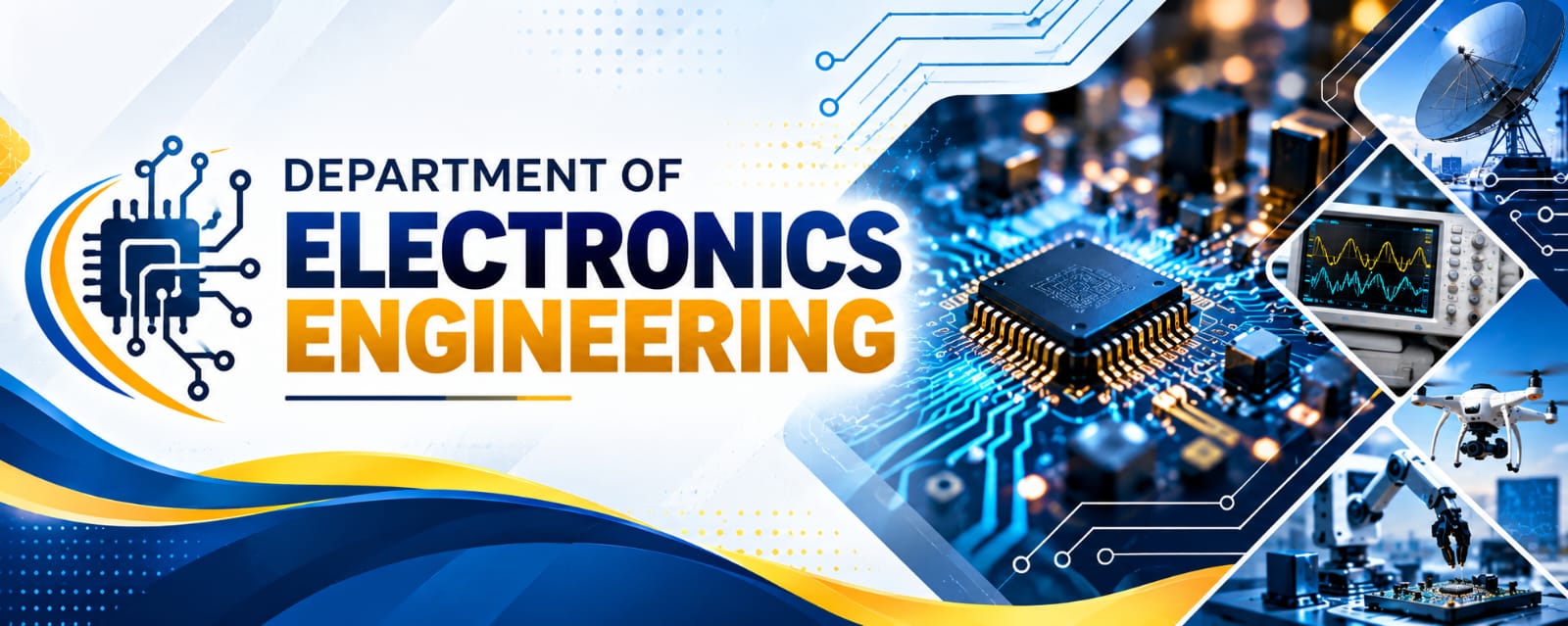
The Electronics Engineering Department is committed to developing technically competent, innovative, and industry-ready diploma engineers through Outcome-Based Education (OBE) and hands-on learning. The department focuses on core areas such as Electronic Circuits, Digital Electronics, Communication Systems, Microprocessors & Microcontrollers, Embedded Systems, Instrumentation, IoT, and Emerging Technologies.
The department provides students with practical exposure through well-equipped laboratories, project-based learning, technical activities, workshops, guest lectures, industrial visits, internships, and skill-development programmes. Students are encouraged to participate in innovative projects, competitions, technical events, and co-curricular activities to strengthen their problem-solving, teamwork, communication, creativity, and professional skills.
The department continuously promotes innovation, lifelong learning, industry interaction, and entrepreneurship, preparing students for higher education, employment, and emerging opportunities in the electronics and technology sector.

Specializations
Sub-fields of Electronics Engineering
Electronics Engineers should be familiar with the following techniques and tools:
Objectives
Program Educational Objectives (PEOs)
To apply electronic engineering principles effectively in real-world applications.
• To develop technical and employable skills through continuous improvement and lifelong learning.
• To work responsibly as engineering professionals with teamwork and social responsibility.
Outcomes
Program Outcomes (POs)
The Program Outcomes (POs) of the Diploma Program are:
Basic and Discipline specific knowledge: Apply knowledge of basic mathematics, science and engineering fundamentals and engineering specialization to solve the engineering problems. 2. Problem analysis: Identify and analyse well-defined engineering problems using codified standard methods.
Design/ development of solutions: Design solutions for well-defined technical problems and assist with the design of systems components or processes to meet specified needs.
Engineering Tools, Experimentation and Testing: Apply modern engineering tools and appropriate technique to conduct standard tests and measurements.
Engineering practices for society, sustainability and environment: Apply appropriate technology in context of society, sustainability, environment and ethical practices.
Project Management: Use engineering management principles individually, as a team member or a leader to manage projects and effectively communicate about well-defined engineering activities.
Life-long learning: Ability to analyse individual needs and engage in updating in the context of technological changes.
PROGRAM SPECIFIC OUTCOMES(PSO's):
Specific Outcomes
Program Specific Outcomes (PSOs)
PSO 1: Design the electronic circuits for various applications using modern tool and troubleshoot techniques considering safety and environmental.
PSO 2: Collaborate in multidisciplinary teams to solve real time electronics related problem and communicate effectively.